Before the Canon: African Aesthetics
African Aesthetics
African art did not begin with Western recognition. Across the continent, artists and communities had already developed their own languages for beauty, character, power, skill, purpose, and memory—systems of knowledge carried through objects, sound, movement, ceremony, and the body.
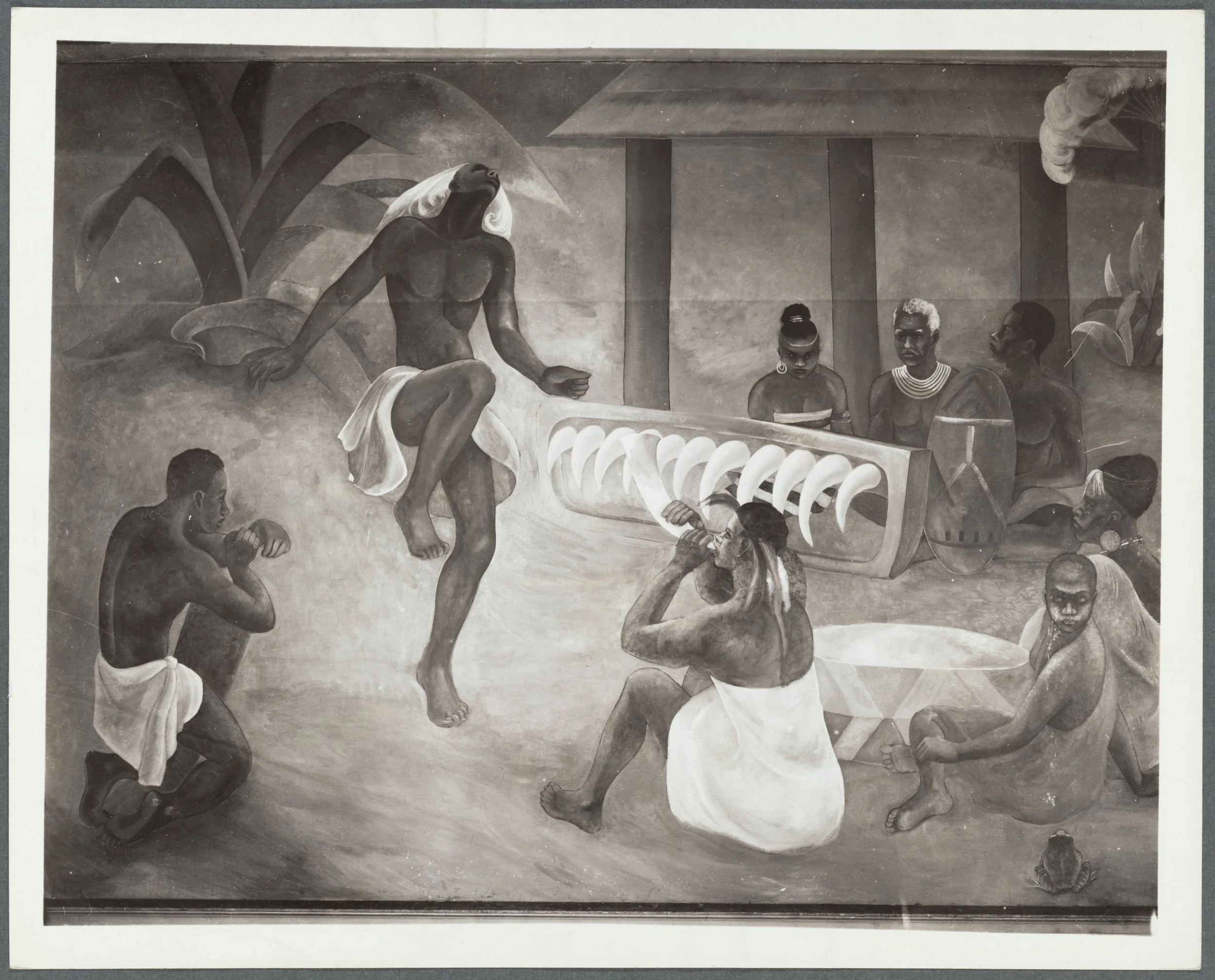
Vertis Hayes, dancer panel from Pursuit of Happiness, 1937. Oil on canvas, Harlem Hospital Center, New York. Photograph courtesy of The New York Public Library Digital Collections.
There is a version of this history that begins with discovery.
An African object enters a Western collection. A curator studies it, assigns it a date, and places it inside a museum. The object is presented as though it has only now entered history—as though its meaning began when a Western institution learned how to name it.
But African art did not begin with Western recognition.
Across the continent, artists were producing work within highly developed cultural, spiritual, political, and aesthetic systems long before European collectors, scholars, and museums encountered it. These works were already being commissioned, performed, interpreted, preserved, and judged according to standards established by the communities that made them.
And these systems were not expressed through objects alone. They lived in metal, clay, ivory, and cloth, but also in sound, movement, language, ceremony, and the body.
To understand African aesthetics before the Western canon, we have to begin there: not with discovery, but with knowledge that was already present.
A Complete Aesthetic Language
Every artistic tradition develops ways of determining what makes a work successful.
In Yoruba aesthetic philosophy, that understanding is expressed through a vocabulary that connects artistic form to character, spiritual force, individuality, and social meaning.
Aṣẹ refers to the vital force carried through visual, verbal, musical, and performative expression. It is the power that allows a work to do more than represent something. A work with aṣẹ can affect the people who encounter it and bring the visible world into relationship with the spiritual one.
Ìwà refers to character or essential nature. Ẹwà, often translated as beauty, is not understood only as visual perfection. Beauty is connected to energy, presence, and the character a work reveals.
Together, aṣẹ, ìwà, and ẹwà describe a relationship between power, character, and beauty. A work is not judged only by what the eye can see, but by the force it carries and the nature it makes visible.
Other concepts extend this language. Ara describes a work’s power to astonish or move its audience. Orí speaks to individuality and inner consciousness. Itutu, often translated as coolness, describes composure, balance, and disciplined command—the outward calm through which power is expressed.
These ideas do not separate artistic judgment from moral, spiritual, or communal life. They belong to a framework in which beauty cannot be fully understood apart from what a work carries, what it does, and the relationships it sustains.
This matters because African art has often been interpreted through categories that were never designed to explain it.
Western institutions separated art from craft, performance from ritual, and aesthetic value from social or spiritual purpose. Within many African traditions, those boundaries were not fixed in the same way. A sculpture could hold spiritual meaning, communicate political authority, preserve cultural memory, demonstrate extraordinary technical skill, and possess aesthetic power at once.
The work did not become less sophisticated because its beauty had a purpose.
Scholars including Robert Farris Thompson devoted decades to tracing how African aesthetic philosophies shaped artistic life across the diaspora. Thompson studied Yoruba dance and sculpture together, resisting the idea that an object could be fully understood after being separated from the movement, sound, belief, and community that gave it life.
The language of aesthetic judgment was already there.
The West did not bring it. The West encountered it.
“African art did not begin when the West learned how to classify it. The knowledge, the standards, and the artistic lineages were already there.”
What the Objects Carry
The surviving works make the depth of these traditions visible.
In what is now southeastern Nigeria, the metalworks of Igbo-Ukwu date to approximately the ninth century. Created through lost-wax casting, intricately worked vessels and ceremonial objects reveal an extraordinary command of metal and ornament.
In the Yoruba city of Ile-Ife, artists produced terracotta and metal portrait heads between roughly the twelfth and fifteenth centuries. Their precise features, carefully modeled surfaces, and vertical markings demonstrate an artistic tradition attentive to individual presence, composure, and sacred kingship.
In the Kingdom of Benin, specialized court guilds produced brass plaques, altar heads, ivory carvings, and ceremonial objects for the Oba. These works recorded royal history, affirmed political and spiritual authority, and preserved the memory of people and events within the palace.
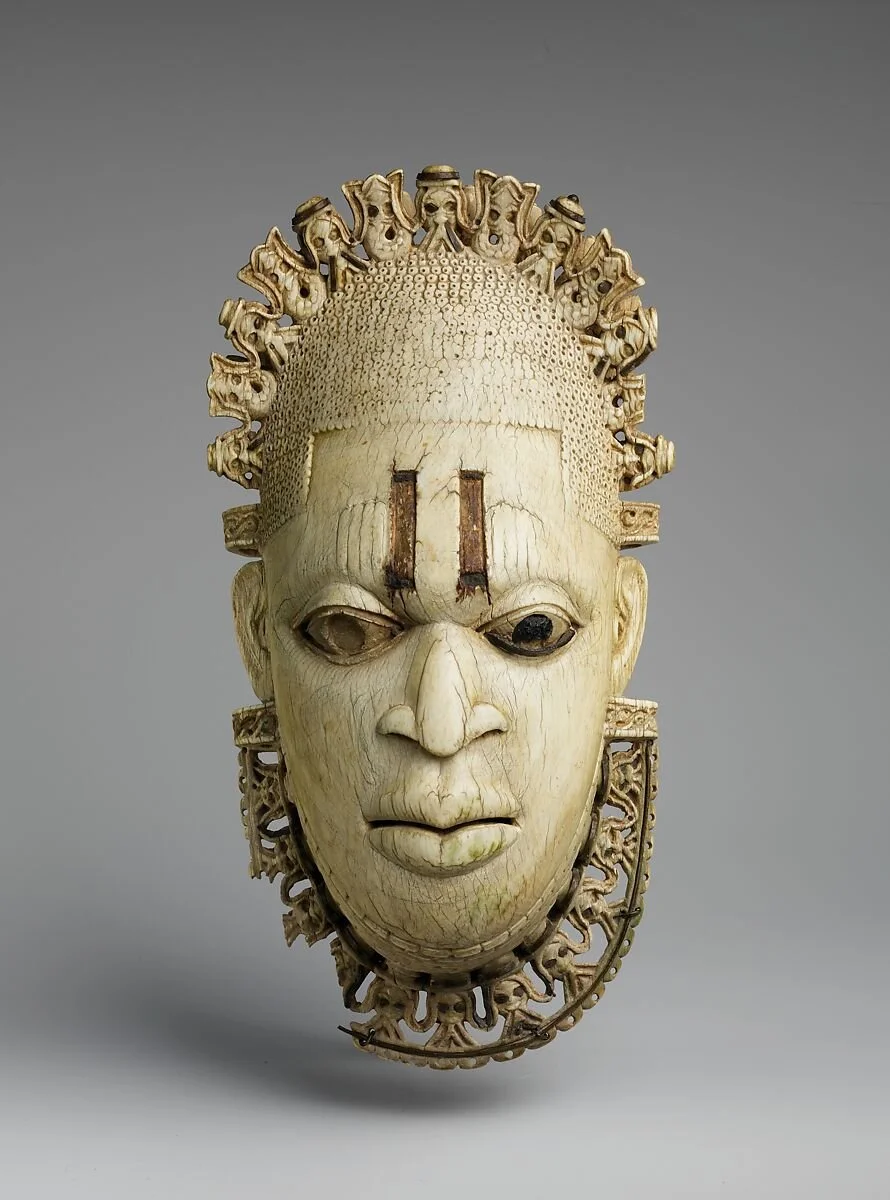
Ìgbèsànmwà ivory- and wood-carving guild artists, Pendant Mask of Ìyọ́bà Idià, 16th century. Ivory, iron, brass, coal, and traces of iron oxides. Court of Benin, Nigeria. The Metropolitan Museum of Art. Public domain.
Across present-day Ghana, Asante and other Akan artists developed equally complex traditions in weaving, metalwork, woodcarving, and royal regalia. Kente cloth communicated identity, rank, history, and philosophical meaning through pattern and color. Cast-gold ornaments and brass goldweights joined aesthetic invention to systems of leadership and trade.
These traditions were not early attempts to arrive at a later Western standard.
They were complete artistic systems with their own materials, techniques, institutions, symbols, patrons, and measures of excellence.
What the Voice and Body Carry
Not every archive is written, and not every work survives as an object.
Among Mande peoples across present-day Mali, Guinea, Senegal, and Burkina Faso, hereditary musicians and historians known as griots—or jali and jeli—have carried genealogies, histories, and collective memory through performance. At naming ceremonies, marriages, and other significant gatherings, the griot does more than entertain. Through story, poetry, and instruments such as the kora, balafon, and ngoni, the griot preserves knowledge by renewing it before a community.
The structure of the music carries its own philosophy. In polyrhythm, independent rhythmic patterns sound at once without losing their relationship to one another. In call-and-response, a lead voice or instrument is answered by the group. The music is not built around passive reception. Participation is part of its form.
The influence of this structural knowledge did not move in only one direction. The ethnomusicologist Simha Arom’s study of Central African polyphony and polyrhythm helped shape the later compositional language of György Ligeti. A rhythmic architecture long treated by Western observers as primitive became part of the work of one of Europe’s most significant twentieth-century composers.
Dance carries knowledge through the body.
Among the Akan people of Ghana, Adowa uses codified gesture to communicate grief, respect, praise, and celebration. Agbekor, practiced among Ewe communities in Ghana and Togo and Fon communities in Benin, developed from a dance associated with warfare and later became part of funerals and festivals honoring ancestors. Among the Wolof people of Senegal, sabar can name the drum, the music, the dance, and the gathering itself.
The language matters. A single word holding sound, movement, and communal event tells us that these were not separate arts assembled after the fact. They were parts of one experience.
African dance traditions are distinct and should not be reduced to one continent-wide style. Still, principles such as polycentrism—several centers of movement operating independently within one body—reveal an aesthetic logic different from the single, unified line privileged in many Western concert traditions. The dancing body can hold several rhythms at once, just as the music does. The community may answer, join, witness, and shape what unfolds.
A song can preserve a genealogy. A gesture can carry social meaning. A rhythm can organize memory across generations.
Their archives were living ones.
When the Arts Move Together
Masquerade makes the limits of Western artistic categories especially clear.
Among the Yoruba, Egungun performance brings ancestral presence into relationship with the living. The performer disappears beneath layers of constructed cloth as music, poetry, dance, mime, costume, and sculpted form become one event. The work cannot be located in the garment alone, because the garment is made complete through movement, sound, lineage, and the knowledge of the people gathered around it.
Gẹlẹdẹ performance similarly brings carved headdresses, elaborate dress, drumming, song, poetry, satire, and dance together. It honors the spiritual power of women and motherhood while using public performance to reflect the community back to itself.
These traditions belong to specific Yoruba histories; they do not stand in for all African performance. But they reveal why separating the object from the performance can distort both.
The mask was not the complete work.
The complete work was the performance.
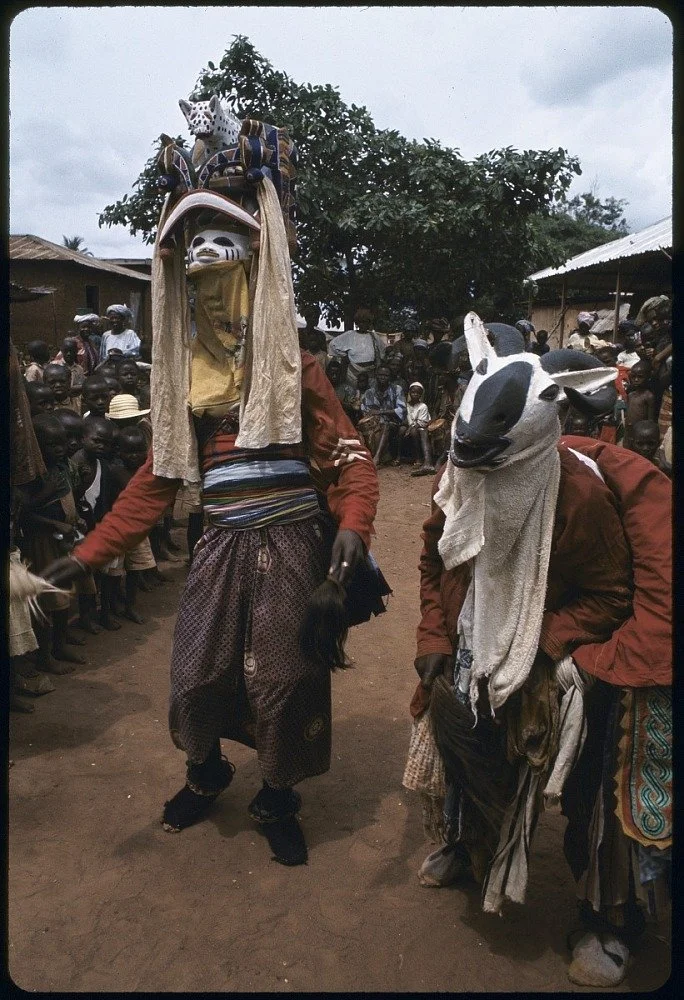
Eliot Elisofon, masked dancers during a Gẹlẹdẹ performance, Meko, Nigeria, 1970. Eliot Elisofon Photographic Archives, Smithsonian National Museum of African Art.
This was already a canon: not because every tradition followed the same rules, but because these traditions possessed their own standards, methods of transmission, forms of criticism, and systems of memory.
What the Western Canon Carried Forward
When Black artists gained entry to Western concert traditions, they did not arrive without history. They carried these structures with them.
William Grant Still’s Afro-American Symphony, premiered by the Rochester Philharmonic in 1931, placed a twelve-bar blues progression inside European symphonic form and built call-and-response into its orchestration. Samuel Coleridge-Taylor’s Twenty-Four Negro Melodies, published in 1905, treated West African, West Indian, and African American melodies as serious compositional material—the same authority European composers had long claimed for their own national folk traditions.
The same tension is visible in dance. Classical ballet built its aesthetic around uniform lines, a narrow physical ideal, and a corps de ballet expected to appear visually consistent. Whiteness was treated as neutral. Black dancers were denied roles for disrupting that uniformity, and some who entered white companies were required to paint their skin.
In the same era, Katherine Dunham studied anthropology and conducted fieldwork in Haiti, Jamaica, Martinique, and Trinidad. Her research became the foundation of a technique that brought Afro-Caribbean movement principles into conversation with ballet and modern dance. Pearl Primus later studied dance traditions in Liberia, the Gold Coast, and Nigeria with similar rigor. Their work did not need ballet’s permission to hold technique, theory, or history.
On the stage, Yoruba artists were also building contemporary forms from indigenous systems. Hubert Ogunde drew from Egungun masquerade, song, and popular theatre in establishing Yorubaland’s first contemporary professional theatre company. Duro Ladipo’s Ọba Kòso joined Yoruba history, ritual poetry, rhythm, dance, and indigenous instruments in a work that toured internationally. Wole Soyinka’s Death and the King’s Horseman later drew structurally from Yoruba ritual poetry and Egungun tradition.
Western institutions often described these works by reaching for familiar labels: symphony, ballet, opera, theatre. Those terms can make the forms legible to a Western audience. They can also conceal the older systems of knowledge the artists carried into them.
The point is not that African traditions became legitimate when they entered Western forms.
The point is that Western forms were changed by what Black artists brought with them.
Extraction and Reclassification
European colonial expansion did not simply remove African objects from their places of origin. It also changed the terms through which African artistic traditions would be understood.
In 1897, British forces invaded Benin City in what was called a punitive expedition. The royal palace was looted, and thousands of objects were taken. Brass plaques, commemorative heads, carved ivories, and ceremonial works were sold and dispersed across museums and private collections in Europe and North America.
Today, these objects are collectively known as the Benin Bronzes, although many are made of brass.
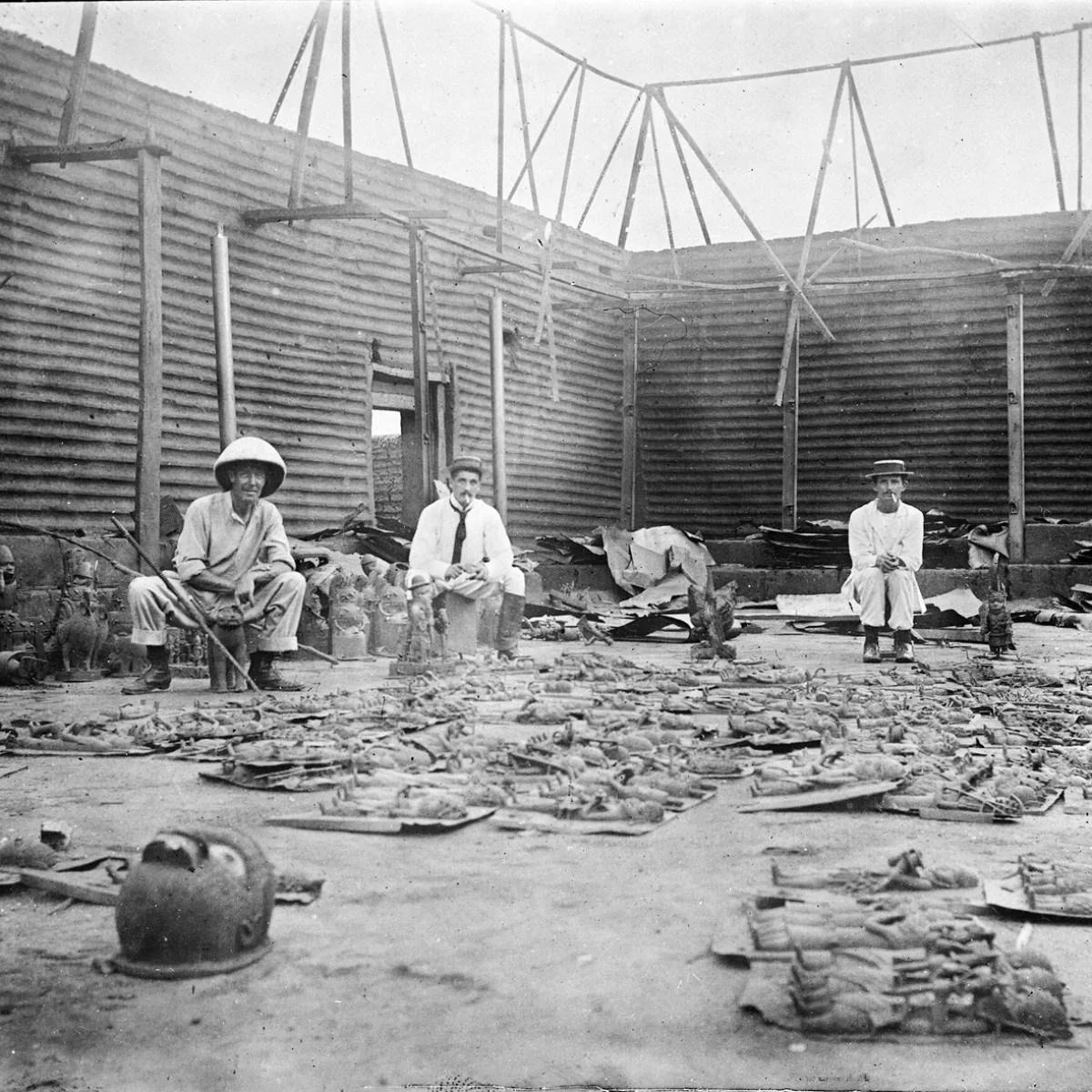
Interior of the Oba’s compound following the British invasion of Benin City, February 1897. Photograph attributed to Reginald Kerr Granville.
Once removed from Benin, the objects entered institutions that often classified African works as ethnographic evidence rather than fine art. They were used to represent a people or a culture, but were not consistently studied as the products of artistic intelligence.
This distinction shaped where the objects were placed, who studied them, and how audiences were taught to see them.
European painting and sculpture entered art museums and art-history curricula. African objects were more often placed in natural-history or ethnographic museums, separated from the aesthetic and intellectual traditions that had produced them. Music, dance, theatre, and masquerade were diminished through a related logic: classified as folklore, custom, or ritual rather than approached as forms with their own technique, structure, and criticism.
The classification was never neutral.
By removing a work from its language, lineage, and use, an institution could make it appear anonymous. It could admire the form while disregarding the artists, philosophies, and systems of knowledge behind it.
African art was not outside the category of fine art because it lacked aesthetic complexity.
It was placed outside that category because Western institutions had defined fine art around their own traditions.
The Question of Return
The history of extraction is now being confronted through restitution.
In 2022, German museums transferred ownership of roughly 1,100 Benin objects to Nigeria. The Netherlands returned 119 works in 2025, the largest single physical return to date.
Other institutions have followed. The Museum of Fine Arts, Boston returned two works directly to the Oba of Benin in 2025. In 2026, the University of Cambridge transferred legal ownership of 116 objects, although the physical handover of most remains pending. Swiss museums also returned 18 works.
The British Museum still holds roughly 900 objects from Benin. British law sharply restricts the museum’s ability to permanently remove works from its collection, and proposals for long-term loans have not resolved the underlying question of ownership.
The same machinery that decided African objects belonged inside a colonial museum is now deciding, slowly and on its own terms, whether they can leave.
Restitution matters because these objects were not freely given. Their return acknowledges that the authority of a museum collection cannot be separated from the conditions through which that collection was built.
But return is not the end of the work.
Return Without Restoration
A returned object is not the same as a restored tradition.
Reporting on Nigeria’s bronze-casting guilds has raised a concern that reaches beyond metalwork. Restitution that focuses only on historical objects—without supporting living artists, apprenticeships, materials, patronage, and the transmission of technique—can bring the pieces home while the knowledge that made them continues to erode.
The same warning applies wherever a tradition depends on one body passing knowledge to another. A griot’s training, a masquerade company’s choreography, or a dance carried gesture by gesture cannot be packed into a crate and returned.
An object can survive without its original context. A living lineage survives only through practice.
"Return changes the location and ownership of an object. Restoration rebuilds the conditions that allow knowledge, skill, and meaning to continue.”
Recognition can create the appearance that the work is finished: a name restored to a wall, an object restored to a country, a tradition admitted into the history of art. But recognition is not the same as continuity.
Restoration must also protect the people who carry the knowledge forward.
Before Western Recognition
The history of Black art does not begin with exclusion from Western institutions. It does not begin when an African object enters a European museum, when a European artist encounters it, or when a Western scholar decides it is worthy of study.
It begins within the cultures that made the work and the systems of knowledge that gave it meaning.
Long before museums, academies, collectors, and historians imposed their own categories, African communities had developed aesthetic philosophies, systems of training and patronage, specialized guilds, sacred traditions, material knowledge, and methods of preserving cultural memory. They had their own vocabularies for beauty, power, character, balance, individuality, and effect.
Some of that knowledge lived in objects. Some lived in voices, rhythms, gestures, ceremonies, and bodies. None of it required Western recognition to become art.
To understand these traditions only through their influence on Western art is to continue the same distortion that removed them from their histories in the first place. They were not a prelude to modernism. They were not raw material waiting to be transformed. And they did not become art when a museum placed them behind glass.
They were already art. Already knowledge. Already evidence of intellectual, spiritual, and artistic worlds with standards of their own.
The work now is not simply to place African art inside the canon as it currently exists. It is to reconsider the canon from the beginning: to ask whose language has shaped our understanding of artistic value, whose systems of knowledge have been dismissed, and what becomes visible when African traditions are allowed to define themselves.
Before the canon named them, these traditions already knew what they were.
Further Study
The record continues.
Return to the Codex for future issues, archival sources, and monthly essays on Black artistic lineage.
Back to the Codex